
Black Preppers.
Ready, together.
Preparedness is part of caring for our people. Explore Black voices in self-reliance, make a plan for your household, and build on the knowledge we pass forward.
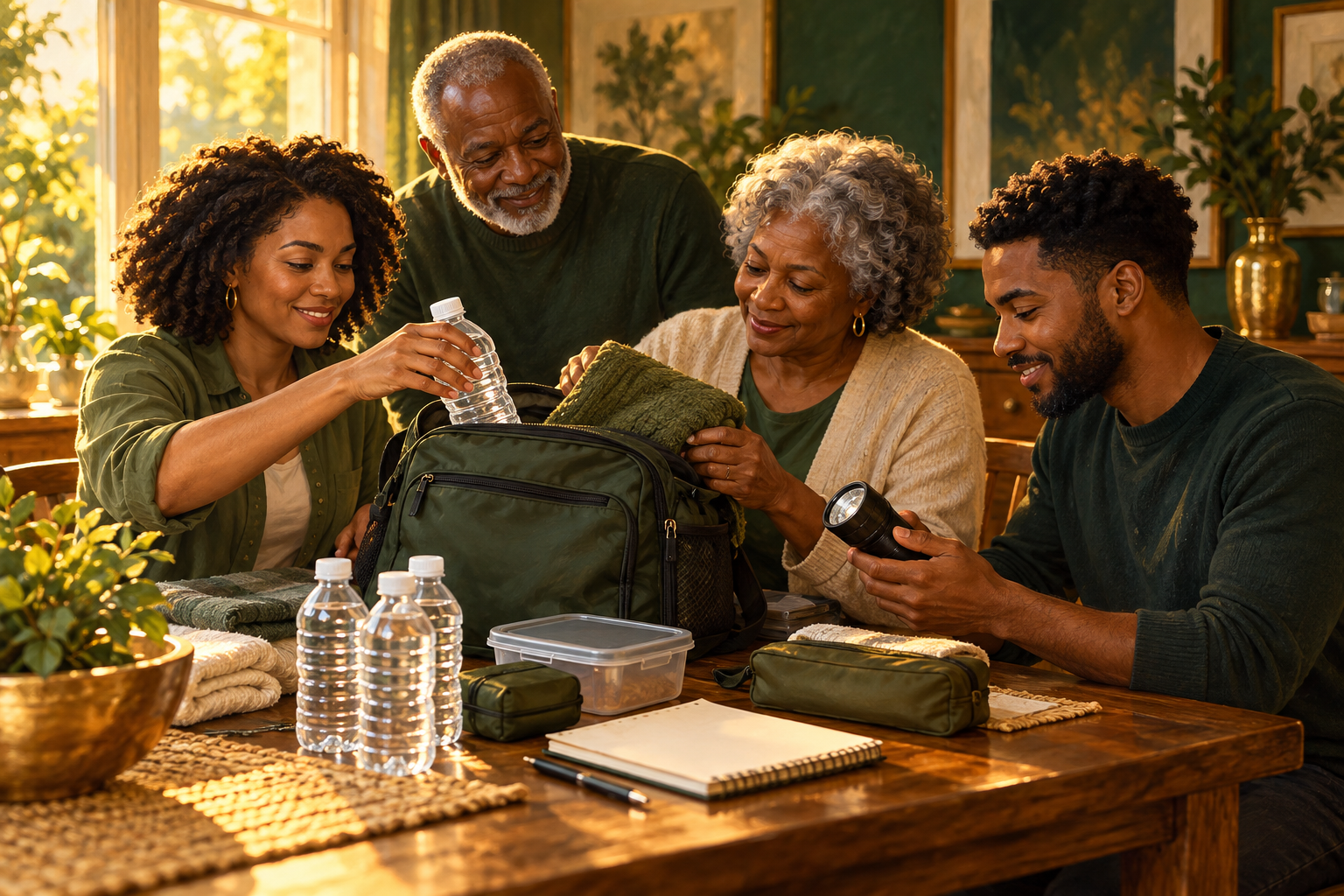
We belong in the
preparedness story.
When you hear the word “prepper,” who comes to mind? There should be room in that picture for a Black grandmother, a family at the kitchen table, a survival instructor, and a woman building a different life on her own land.
This conversation can begin close to home: Who will we call? What do we already have? What would help us look after one another if our usual routines were interrupted? Those questions deserve a place at our tables, alongside the stories and skills we want the next generation to carry.
Sharon Ross, Hakim Isler, and Zani Sunshine offer three distinct paths into that conversation. Ross speaks from a history of homesteading and preparedness. Isler brings a background in survival training. Sunshine shares her work on household planning and off-grid living. Their experiences invite us to look more closely at who teaches these skills, whose knowledge gets recognized, and where our own households might begin.
The people behind the work.
Different experiences, different approaches—and real stories worth exploring.

Sharon Ross
On her own website, Ross recalls growing up on a Southern Oregon homestead, where her family gardened, raised animals, and worked together to provide for themselves. She describes lessons learned from her father and a lasting appreciation for the outdoors. Preparedness, in that account, grows from lived experience and family teaching.
In Maryann Reid’s 2020 Forbes interview, Ross connects homesteading with readiness for disruption while distinguishing rural self-sufficient living from the preparations people make in cities and suburbs. She also recalls her grandmother’s household practices. That connection between generations gives her story a place in a larger conversation about skills we keep, share, and sometimes need to learn again.
Her story asks a useful question for our families: What knowledge do we already have, and who is helping us pass it on?

Hakim Isler
Isler’s official biography traces his survival training through the U.S. Army’s Survival, Escape, Resistance and Evasion school and later study at Earth Connections Survival School in Virginia. It describes work in wilderness and urban survival, alongside his military and martial arts background.
The biography also describes his involvement in The SOIL Foundation and its outdoor work with veterans and young people. His profile brings a different dimension to this collection: the time, practice, and instruction behind specialized skills.
For a reader beginning at home, the invitation is to be curious about learning. Identify a skill you want to understand, then look carefully at the instructor’s training, the activity, and whether it fits your needs. A biography can introduce a teacher; it cannot replace the teaching itself.

Zani Sunshine
Jennifer Gerson’s 2025 reporting for The 19th describes Sunshine’s move from Atlanta to rural New Mexico with her family and the homestead they developed there. It also describes how her online work reached Black women looking for a more approachable way to think about preparedness.
On her own About page, Sunshine presents her work as off-grid planning and education. Her publication, OFFGRID CONNECTIONS, covers preparedness, survival, and homesteading. These are her own resources, separate from NBWSAA.
Her story opens a conversation about planning before making a major change. Readers can explore that journey without assuming that every household needs land, a trailer, or an off-grid move. Our starting question can be smaller: What would help us understand our own needs and make a thoughtful next decision?
Bring the knowledge home.
These three people do not have the same story, and their choices are not a single prescription for our lives. What we can bring home is a willingness to ask questions, learn useful skills, and include one another in the planning. Start with a conversation. Use official local guidance. Make room for the people who will depend on the plan.
Read the original reporting.
The two articles behind this collection, with the writers and publishers clearly identified.
They’re not your typical “preppers,” but thousands look to them for survival tips
Meet Black women whose stories bring preparedness and off-grid living into view, including Sharon Ross and Zani Sunshine.
Read at The 19thRead the credited republication ↗
Changing The Face Of The White Prepper
A historical interview with Sharon Ross, known as Afrovivalist, exploring her perspective on preparedness and self-reliance.
Read at ForbesArticles open on their publishers’ websites; access terms may vary. The family-readiness artwork and homestead drawing are illustrations.
Homestead Heart.
Keeping the knowledge
in the kitchen.
Growing food. Learning the tools. Making room for the next person to learn.
A cupboard can hold more than groceries. It can remind us of a grandmother who planned ahead, someone who made the harvest stretch, or the first person who let us stand beside them and ask questions. Those memories give us a reason to keep learning.
Homestead Heart brings practical household work into view through videos about homesteading, growing food, canning and preparedness. For readers looking for a Black woman sharing this work, her channel offers a place to begin exploring.
The channel's beginner collection includes introductions to canning tools, jar sizes, pressure canners and water-bath canners. One equipment video, published in 2017, introduces different kinds of canners and encourages newcomers to research the equipment that fits their needs. It gives a beginner a useful question to take into further study: What do I need to understand before choosing my tools?
The lesson can begin before the stove is on.
Our invitation is to watch with a notebook. Write down unfamiliar equipment names. Notice the questions you still have. Think about the foods your household uses and the space available to store them. Learning together can make it easier to ask for help before spending money or starting a project.
That is where this story meets our preparedness work: a household taking time to understand its needs, a caregiver making a plan, and knowledge becoming something another generation can use. A grandmother on a limited income can begin by checking her cupboards and listing what she already has. Preparing thoughtfully should leave room for the household's budget.
Meet her. Explore the work.
- Homestead Heart — original YouTube channel
Explore her own videos and descriptions. - Canning For Beginners ~ Pressure Canner & Water Bath Canner
Equipment introduction, June 17, 2017. Link and publisher description checked; full video procedure has not been audited. - Canning @ Homestead Heart — creator's playlist
Browse her collection. Individual recipes and procedures require separate checking before use. - National Center for Home Food Preservation — canning reference library
Read the complete tested directions for your specific food and method.
Carry the knowledge forward with care.
For actual preservation, follow a current tested recipe from USDA, the National Center for Home Food Preservation or your university Extension service, including its equipment, jar size, processing and elevation directions. A creator profile introduces the person; each food-preservation method still needs its own verification.
Start with one small planning task: inventory the food you already have, note what your household regularly eats, and write down one skill you want to learn. Invite someone to learn beside you.
Start where you are.
Use what you have.
You don’t have to do everything today. Choose one starting point and give your household a little more clarity.
Make a household plan
Begin with a shared contact and a meeting place. Bring the people in your household into the conversation.
Show my first step
Start a conversation about one person everyone can contact and a meeting place everyone understands. Use the official family guide to develop the rest of your plan.
Open the official guide ↗Review your supplies
Take stock before buying. Use an official checklist to see what your household already has and what needs attention.
Show my first step
Write down what you already have. Compare your list with the official guide, then decide what your household needs to review next.
Open the official guide ↗Know your local resources
Find your city or county emergency management office and learn where official local information comes from.
Show my first step
Identify your city or county emergency management office through its official government website. Review its local planning information and alert options.
Open the official guide ↗Your household preparedness workbook.Download 11 printable and fillable pages for supplies, contacts, food and water, household wattage, battery sizing and practice logs. Calculations are manual. Save completed copies privately.
Download the kit (PDF)Your household preparedness guide.
Supplies, affordable steps, contact planning and trusted community connections.
Preparation helps households and neighbors plan before a storm, outage or other disaster. Build supplies, make a contact plan and find a group that fits your community.
Start here: FEMA’s Ready.gov Build a Kit guidance calls for supplies to last several days. The short home checklist below is cross-checked against Michigan’s official emergency kit checklist. Use the full official lists and local instructions to tailor your kit.
Home supply checklist
- Water: Plan for one gallon per person each day for drinking and sanitation; keep supplies for several days.
- Food: Keep nonperishable food your household can eat, with a manual can opener.
- Light and information: Flashlights, spare batteries, a battery-powered radio and a NOAA Weather Radio with alerts.
- Basic care: A first aid kit, hygiene supplies, wipes and waste bags.
- Personal needs: Medicines, glasses, infant items and pet supplies as needed.
- Important items: Paper contact details, local maps, some cash, and copies of essential documents in a portable waterproof container.
- Warmth: Suitable clothing, sturdy shoes and blankets for your household and climate.
Stock up a little at a time
These are practical starting steps; choose what fits your budget and space.
- Check what you already have. Write down missing items before buying.
- Add a few needed items during regular shopping. Prioritize water, food, light and your household’s essential needs.
- Choose familiar shelf-stable foods. Check dates, use older supplies first and replace what you use.
- Keep supplies together where household members can find them. Keep portable essentials ready if you must leave.
- Review your kit when household needs change and before your area’s severe weather season. Test lights and radios and replace spent batteries.
Have ready: Household size, dietary and access needs, pet needs, available storage and a realistic shopping amount.
Next step: Make a short missing-items list and complete one affordable step today.
Make a household contact plan
Write down how to reach one another, where to meet if separated and who outside the area can relay messages. Plan for people who need help with communication, mobility or transportation. Discuss what to do if phones or power are unavailable.
Official planning resource: Ready.gov Make a Plan. Follow local alerts and evacuation instructions.
Form a neighborhood preparedness group
A readiness circle can bring together trusted neighbors, relatives, a congregation or a community organization. Start with a small planning meeting.
- Agree on a purpose: sharing reliable alerts, making kits and checking on one another.
- Choose a coordinator and a backup. Make a voluntary contact chain and agree when to check in.
- Ask what help members want to share and what support they may need. Include language, disability, transportation, children and pets.
- Keep private contact details within the consenting group. Agree how to update the list.
- Practice a check-in and review the plan together. Ask your local emergency management office about training.
Have ready: A meeting place, your community’s likely hazards and a simple proposed check-in plan.
Next step: Invite a few trusted people to plan together. The City of Austin’s neighborhood preparedness guide offers templates and contact-chain guidance as a public example; use your own locality’s hazard instructions.
Join an existing group or CERT program
Ask a local Black organization, faith community or neighborhood association whether it has a preparedness group. Confirm who runs it, the activities, accessibility, time commitment, any costs and how it works with local officials.
For a structured volunteer route, explore FEMA’s Community Emergency Response Team (CERT) program. Contact your local emergency manager about available classes and participation requirements.
FEMA’s IS-317.A introduction to CERT explains the program. FEMA states that this online introduction does not replace local CERT Basic classroom training required to become a CERT volunteer.
Next step: Find your city or county emergency management office through its official government website and ask about local preparedness groups or CERT training.
A neighborhood readiness circle is not automatically a CERT team. Keep activities within members’ training and follow official response instructions. This guide does not establish an NBWSAA group or enroll anyone.
Preparedness sources checked October 6, 2026. Canning and food-preservation instruction remain deferred.
Know more. Prepare together.
Curious about preparedness and survival skills? There is room to read, watch, ask questions and plan at your own pace. Start with everyday readiness, then explore the knowledge you want to build.
Choose a starting point
Read household preparedness basics — explore the Red Cross planning and supplies hub.
Plan around your everyday needs — read the Red Cross guidance for older adults and discuss support with someone you trust.
Learn one step at a time — browse Washington’s Prepare in a Year topics and recorded webinar. Adapt examples to your own location.
Try this while seated: Choose one resource, keep a page of notes and write one question or manageable next step. Reading and planning are separate from lifting supplies, outdoor practice or training; arrange help for physical tasks as needed.
Use the household guide above for supply checklists, budget steps, contact planning and neighborhood resources. These public reading routes do not enroll you in a group or provide a training credential.
Land. Nature.
Knowledge passed on.
Preparedness connects with other conversations about caring for the land, enjoying the outdoors, and telling our own stories. Explore each person’s work in its own context.
Bring the conversation home.
Gather your household, choose one planning task, and use the Michigan Family Preparedness Guide to help you work through it.
Open the official guideMichigan resource · For other locations, consult your local emergency management office.
NEW BLACK WALL STREETS ACROSS AMERICA · HOUSEHOLD STARTER SHEET
One conversation. One first step.
A starting point to use alongside your local emergency guidance. Keep your completed sheet private.
Choose a starting task
- ☐ Talk through our contact and meeting place.
- ☐ Review supplies using an official checklist.
- ☐ Find our city or county emergency management office.
Official starting resource: Michigan Family Preparedness Guide
https://www.michigan.gov/miready/family-preparedness-guide
For other locations, consult your local emergency management office. This sheet is educational and does not replace official instructions.