
Unapologetically Shop Black.

Browse businesses and resources · Add your business for review
THE GREEN BOOK LEGACY—REIMAGINED FOR THE DIGITAL AGE
Beginning in 1936, Victor Hugo Green’s Negro Motorist Green Book helped Black travelers find businesses, lodging, services, and places where they could be received with greater dignity during the era of segregation.
It was more than a travel guide. It connected Black consumers with businesses, strengthened economic relationships, and demonstrated the power of using information to protect and advance our communities.
Inspired by that historic legacy of dignity, connection, self-determination, and collective economic power, New Black Wall Streets Across America is building a modern digital pathway to Black-owned businesses, professionals, organizations, and community resources across America.
This initiative is not a reproduction, replacement, or official continuation of the historic Green Book. It carries its community-centered economic spirit forward for a new generation.
FIND BLACK BUSINESSES. CONNECT ACROSS AMERICA.
SHOP BLACK. BUILD BLACK. RESTORE THE WEALTH.

Victor Hugo Green. Scan of the New York Public Library copy, via Wikimedia Commons.

FROM THE GREEN BOOK TO A DIGITAL DIRECTORY
THE HISTORIC GREEN BOOK
• Printed travel guide
• Helped Black travelers find welcoming businesses, lodging, food, and services
• Organized information geographically
• Strengthened dignity, mobility, and consumer choice
• Directed economic support toward businesses serving Black communities
• Updated through new printed editions
THE NBWSAA DIGITAL DIRECTORY — IN DEVELOPMENT
• Planned searchable nationwide digital resource
• Intended to connect people with Black-owned businesses, professionals, organizations, and community resources
• Designed to organize information by location, category, and purpose
• Intended to strengthen visibility, connection, ownership, and economic circulation
• Will help communities identify both existing assets and unmet needs
• Can expand and be updated as the directory is developed and approved
INSPIRED BY THE LEGACY. BUILT FOR TODAY. CONNECTING BLACK AMERICA FOR TOMORROW.
Request your Digital Green Book PDF
Use the form below to request a copy. NBWSAA records your request and checks your Supporting Member eligibility before arranging delivery.
Online viewing is free. Any-amount financial support provides the contributing person with 30 days of Supporting Member benefits, including PDF eligibility during that period. An account or application alone does not qualify.
The full guide is still being completed. Submitting this form records a request; it does not start a download or promise a delivery date.
Questions about your request? Contact info@newblackwallstreet.org.
DIGITAL GREEN BOOK
Discover what our communities already have—and what we still need to build.
Explore the Public Directory Add Your Business Plan & Print Your Trip Receipts & ReturnsOn the Contact form, select ‘Add My Business to the Black Business Guide.’
The Digital Green Book (DGB) from New Black Wall Streets Across America helps people discover Black-owned businesses, community organizations, institutions, resources, opportunities, and information.
Why the Digital Green Book Matters
Our communities already contain knowledge, talent, businesses, land, organizations, and institutions. When those assets are difficult to locate, they are also difficult to support, connect, strengthen, and preserve. Finding what exists is the first step toward building what is missing.
What You Can Find
- Black-owned businesses and service providers
- Community organizations and institutions
- Educational and economic-development resources
- Builder opportunities and areas of need
- Information that helps communities connect and act
Safety & Travel
Useful information should help Black people travel, work, relax and make a home with dignity. Use the questions below alongside current local information. A business listing or a historical record is not a safety certification.
Before you travel or book a stay
- Confirm lodging, meals, fuel or charging, restrooms, operating hours and late-arrival arrangements directly with the provider.
- Check accessible entrances, transport options, current closures and weather. Identify another stop if your plans change.
- Keep key addresses and contacts available offline. Share your route and expected return with someone you trust.
- Separate a provider's own claims, a dated visitor experience and independently documented information.
National Park Service trip-planning guide (opens a new tab) includes park alerts, backup plans and a trusted-contact trip plan. Check the specific destination before leaving.
Working, relaxing and choosing where to live
For work, consider travel to the job, after-hours arrangements, reported racial harassment and available independent help. For recreation, check access rules, return transport, accessibility and current advisories.
When researching a place to live, compare dated evidence about racial intimidation or violence, housing-discrimination resources, local Black community institutions and practical emergency support. Ask what period and area a report covers, which agencies supplied data and what information is missing. A low reported count does not establish that no risk exists. We do not rate a place by its racial makeup.
Historical sundown towns and present-day concerns
During segregation, some communities excluded Black people after dark through rules, threats or violence. The National Park Service discusses this historical danger in its account of the Green Book. Historical labels describe a documented period; they do not establish a place's present conditions.
Read the NPS historical context (opens a new tab). For any place-specific entry, identify the location, period, source and evidence status. Keep historical evidence separate from current reports.
Reported incidents, hangings and disputed deaths
Concerning incidents and deaths deserve careful, respectful documentation. For a case entry, distinguish verified facts, official findings, documented family or attorney concerns, and unanswered questions. Attribute allegations and show when an investigation or finding changes. A reported hanging alone does not establish cause, criminal responsibility or racial motive.
Selected historical public records and a place-research worksheet follow below; this is not a complete case list or a safe-place ranking. We will not fill missing evidence with speculation or dismiss documented concerns because a case is disputed.
DOJ hate-crime and incident reporting resources (opens a new tab). NBWSAA's community input is not an emergency service.
Research a place before traveling or moving
Compare the same area and period using several sources. Keep your notes privately and record when you checked each source. Population makeup is not a safety measure.
- Location and purpose: name the city and neighborhood, the dates, and whether you are visiting, working or considering a home.
- Reported incidents: check the FBI hate-crime data and reporting explanation. Record the reporting agency, year, coverage and missing data. Different reporting participation can distort comparisons; no report is not proof of no risk.
- Current local conditions: check official alerts, operating hours, transportation and emergency arrangements for the actual destination. A historical record does not establish current conditions.
- Community support: identify local Black community institutions and practical contacts using the existing directory. Ask directly about current services, hours and eligibility.
- Housing concerns: use HUD's housing-discrimination reporting information when relevant. The source explains its own process and timing; an NBWSAA submission is not a HUD filing.
- Your conclusion: write what the evidence supports, what remains unknown, a backup plan and the date to check again. Do not turn incomplete reports into a safe/unsafe label.
Record fields: place | purpose | period | source and publication date | finding | reporting limits | checked date | next review. This is a research worksheet, not a ranking or a guarantee.
Historical place record: Glendale, California
Period: twentieth-century exclusion; city acknowledgment adopted September 15, 2020. Glendale Library, Arts & Culture's ReflectSpace exhibit explains that city and library archives supported a report and resolution acknowledging the city's sundown-town history.
Evidence status: institutional historical interpretation and a recorded city acknowledgment. Read the City of Glendale library exhibit and its source trail. No images or archival materials are reproduced here.
What it means today: this establishes documented history and acknowledgment. It does not establish present-day safety, current racial hostility, or that all residents share any view. Use the place-research worksheet for current conditions and practical support.
Record checked October 22, 2026. Historical record, not a current safety assessment. Next editorial review October 29, 2026, or when the cited source changes.
Public case record: Robert Fuller, Palmdale, California (2020)
Confirmed event and official finding: Robert Fuller was found dead in Palmdale on June 10, 2020. The Los Angeles County Medical Examiner-Coroner's July 9, 2020 release identifies hanging as the cause and suicide as the certified manner of death. Read the county's dated finding, case 2020-05108.
Documented family concern: TIME's June 17, 2020 report described the family's request for further investigation and the sister's disagreement with the initial suicide explanation. Read that earlier reporting. It predates the July finding; its pending-investigation language must not be presented as the current official status.
Evidence limits: a family concern and an official finding are different kinds of evidence. These sources do not establish homicide or racial motive. This dated record does not classify Palmdale's current safety or establish a pattern across cases. No graphic imagery or private medical details are reproduced.
Sources read October 22, 2026; official finding cited is July 9, 2020. This is one historical public-record example, not a complete case database or a new investigation. Next editorial review October 29, 2026, or when a later authoritative record is identified.
Source links reviewed October 22, 2026. Next editorial review due October 29, 2026. Each future location or case entry needs its own location, period, sources, evidence status and review dates.

FREE FAMILY TOOL
Plan & Print Your Trip
Your route. Your stops. Your people.
Build a family travel packet with contacts, personal notes and an emergency checklist.
Download your NBWSAA packet, then print the map and driving directions from Google Maps to carry with it. No ChatGPT account is needed.
FREE EVERYDAY TOOL
Receipts, Returns & Warranties
Your purchase. Your paperwork. One place to find it.
Keep the item, seller, receipt location, actual return deadline, warranty and follow-up notes together. Create a private record you can save, reopen and print.
Open my purchase organizer
Entries stay in your open page and your downloaded files. No NBWSAA account or ChatGPT login is needed. Save your editable records file before closing.
Community Preparedness
Know more. Prepare together. Start with everyday readiness. Read, ask questions and plan at your own pace. Choose tasks that fit your household, budget and access needs; arrange help with physical handling when needed.
Home supply checklist
- Water: Plan for one gallon per person each day for drinking and sanitation, with supplies for several days.
- Food: Nonperishable food your household can eat and a manual can opener.
- Light and information: Flashlights, spare batteries, a battery-powered radio and a NOAA Weather Radio with alerts.
- Basic care and personal needs: First aid and hygiene supplies, wipes, waste bags, medicines, glasses, infant items and pet supplies as needed.
- Important items: Paper contacts, local maps, some cash and essential document copies in a portable waterproof container.
- Warmth: Suitable clothing, sturdy shoes and blankets for your climate.
Tailor the full Ready.gov kit guidance and Michigan emergency kit checklist to your household and local instructions.
Stock up a little at a time
Check what you already have and list missing items. Add a few needed supplies during regular shopping. Choose familiar shelf-stable food, use older supplies first and replace what you use. Keep supplies together and portable essentials ready if you must leave. Review when needs change and before severe weather season; test lights and radios.
Next step: Write household size, dietary and access needs, pet needs, storage space and an affordable shopping amount. Make a missing-items list and complete one manageable step.
Make a household contact plan
Write how to reach one another, where to meet if separated and who outside the area can relay messages. Plan for communication, mobility and transportation needs. Discuss what to do if phones or power are unavailable. Follow local alerts and evacuation instructions.
Prepare a separate map-and-directions packet for each meeting place, out-of-area gathering place or evacuation destination in your household plan. Use the existing Family Trip Planner above for printing and storage steps. Keep the actual map with written directions, a current road atlas and private household contacts; follow current official evacuation instructions.
Plan with trusted people or find an existing group
A small readiness circle can include neighbors, relatives, a congregation or a community organization. Agree on reliable alerts, kits and check-ins. Choose a coordinator and backup; make a voluntary contact chain. Include language, disability, transport, children and pets. Keep contact details within the consenting group, practice a check-in and agree how to update the plan.
The Austin neighborhood guide offers a public planning example. Use your own locality's hazard instructions.
Ask a local Black organization, faith community or neighborhood association about existing activities. Confirm who runs them, accessibility, time, costs and coordination with local officials. Ask your city or county emergency manager through its official government website about CERT classes. A neighborhood circle is not automatically a CERT team; keep activities within the training members have completed. The IS-317.A online introduction does not replace local CERT Basic classroom training.
Read and plan at your own pace
Choose Red Cross household basics, older-adult preparedness or Washington's Prepare in a Year. While seated, keep notes and write one question or manageable next step. Reading does not enroll you in a group or provide a training credential.
Continue with our existing Community Preppers guide
Reused from the accepted public NBWSAA Community Preppers and household guide, read October 22, 2026. The underlying household guide labels its source checks October 6, 2026; this reuse is not a new independent audit of every external source. No new NBWSAA group, private feature, kit distribution or enrollment is activated. Canning and food-preservation instruction remain deferred.
Corrections & Community Input
Share a Community Experience
Tell us about a positive experience, travel detail, concern, historical source or correction. Write your experience in the form below. NBWSAA receives it privately for review; submitting does not publish it.
Your name and email are optional. Permission for private contact and permission to consider a de-identified summary are separate, optional and unchecked. You may submit without granting either. Names, photographs, quotations and attachments require separate specific permission. No automatic posting or marketing enrollment.
This is not an emergency reporting service. Business-listing requests use the existing Add Your Business form.
Quick Resources
Black Wealth Transfer: Check Our Progress — See the existing measurement framework and reporting status, then explore Markets & Black Wealth Watch on the same page. Participant results are not yet reported.
Public Directory
Browse 30 reviewed starting resources. Every destination below is publicly available. This page does not provide access to member records, private workflows, or internal organizational tools.
Directories
Marketplaces
Organizations
Featured Businesses
Use the Directory Responsibly
Directory information helps visitors discover and support businesses and community resources. A listing is not an endorsement, certification, guarantee, or promise by New Black Wall Streets Across America. Use your own judgment before making purchases, entering agreements, sharing personal information, or relying on a listed service.
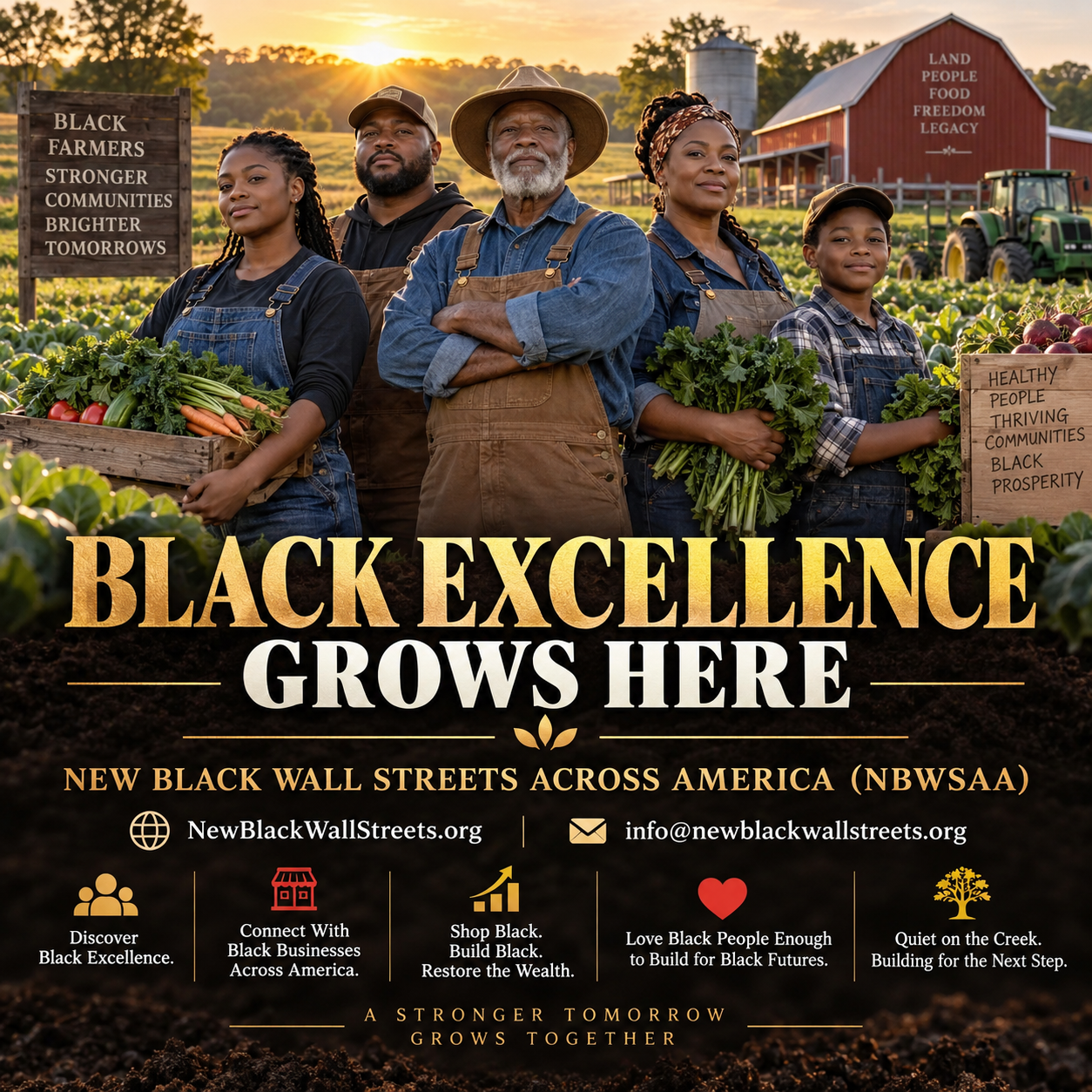
BLACK FARMERS, GROWERS, AND AGRICULTURAL RESOURCES
Black farmers, growers, ranchers, landowners, cooperatives, and food producers are essential to Black economic restoration, food security, land retention, and generational wealth.
Use these resources to discover Black growers, explore agricultural networks, locate technical assistance, learn about cooperative development, and connect with public farming programs.
FIND GROWERS. PROTECT THE LAND. CULTIVATE BLACK WEALTH.
Black Farmers Index — Find Black growers and register a Black farm.
Federation of Southern Cooperatives/Land Assistance Fund — Cooperative development, land retention, estate planning, technical assistance, and advocacy.
National Black Growers Council — Resources, advocacy, and networking for Black production and row-crop farmers.
Black Urban Growers — Urban and rural grower education, advocacy, networking, and the national BUGs conference.
USDA Beginning Farmers and Ranchers — Farm planning, financing, business development, marketing, conservation, and risk-management information.
USDA Service Center Locator — Find local FSA, NRCS, and Rural Development assistance.